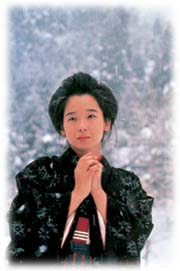
 Tanaka Yuko as Oshin (age 16 to 46)
 According to J-Fan, Japanese TV dramas (or "dorama" as they are often referred to outside Japan) are probably the biggest form of entertainment in Japan. The biggest and most popular actors and actresses in Japan appear in TV dramas, unlike in the U.S. where the biggest actors appear almost exclusively in movies. And Japanese TV drama has spread and become quite popular throughout Asia. The doramas can be categorized into two types: trendy and non-trendy. Usually, the non trendy type includes NHK dramas, "jidaigeki" ("period" dramas), children's shows etc.
The ones that being aired on our free national tv (8TV to be exact) right now are the trendy type. In fact, the trendy type has been garnering much attention in Malaysia. Yet, if we still remember, it was the non-trendy type that started winning the hearts of Malaysians. Let’s reminisce the days when we anticipated the airing of Oshin, Shogun, Ninja, Rin Hanekoma, Akantare and even Moero Attack! Malay vocalization helped us even better to understand the stories. I suppose, most of us already recognize the voices. Yup, the same voices are still being used in the Japan Animes aired on our local tv: for eg. Shin-Chan, Naruto to name a few.
I admit that I do have a 'thing' for anything Japanese: people and products alike. I’ve been buying boxes and boxes of J-Dorama vcds since 4 years ago. (please note, there is no hint of pride there whatsoever). In each box set, normally there are 7 – 8 vcds, rarely 9 – 10 vcds. I used to watch all the cds in one go – my sister and I call this process: vcd marathon. Believe me, I had stopped doing vcd marathon, now I manage to discipline myself to watch only 3 – 4 vcds per-day. :-p
After watching quite numerous number of J-Doramas, I could conclude that the essence in life of a Japanese is ‘spirit’. Be it love story or family story, they always cultivate the spirit of striving for the best. It is really rare to find them giving up on something. Even in mushy-mushy love stories where the characters usually fail miserably in their relationships, they always have this attitude of ‘tomorrow is another day’. What past is past, no need to cry over spilled milk.
And oh yes, the Japanese really value their time. They are also so engrossed with their jobs. I think this is the most interesting criteria of J-Doramas. The doramas always portray how their jobs are done, in details mind you. Let’s take one of my favorite dorama as an example: My Little Chef. The lead actress plays the role of a French Cuisine Chef. In each episode, the viewers will be exposed with methods of cooking a French dish. The same goes with Sushi Master, each episode gives a tip on how to prepare good sushis. Yummy and educational as well! Of course, stories with good food always have a special place in my heart :D
I also got to watch some detective doramas: Files of Kindaichi (adapted from Hajime Kindaichi Anime) and Fugoh Keiji among others. Most of these detective doramas are influenced by Sherlock Holmes’ method in deducting his cases. Though sometimes the plots are illogical, you get to learn lots of deduction skills! The best part is when you succesfully guess the right culprit of the case. If I’m not mistaken, this type of story is called ‘who’s dunnit’ story.
I also notice that some of the western values have been instilled among the Japanese. The most obvious are the Valentine and Christmas celebrations. Though most of them are not Christians, they celebrate Christmas as if they are. Buying each other presents during Christmas is a norm, complete with Christmas trees, Santa Claus, and even Christmas Carol in Japanese! As for Valentine, the girls and ladies will bake chocolate cookies to be given to their loved ones. This is the time when the popular lads will get lots of cookies, openly or in secret (by secret admirers, no doubt).
In case you are wondering why am I babbling about the western influence, I just want to state that it is hard for me to find a dorama in which the Japanese do not look up to the Westerners. This is what one of my Japan graduate friend said, “The Japanese call other Asians as Asians, but they refer themselves as Japanese.” I wonder why? Of course it is wrong to generalize the Japanese, but surely there is some truth in her remark, isn’t it?
To date, my most favourite J-Dorama is Proof of the Man (Ningen no Shumei) which will be aired on 8TV this coming Saturday. (8TV should thank me for promoting this dorama) The reason? It is the first dorama where I get to see the dark side of Japan: how there are still Japanese that hate Americans, the ugliness of its political world etc. Even the English used by the actors in this dorama is really good. I had watched some doramas where the actors are portrayed as people who speak English very well, but once you listen to them you know they only memorize it without even understanding the meaning.
Undeniably, my observation is based on the sample of doramas that I bought and watched. There are more doramas out there, with various type of genres and plots. Still, being a J-Dorama fan, I manage to grasp here and there some Japanese words and sentences. My favorite words: Utso (You are lying!), Asoka (Oh, like that) and many more... :D. Hmm.. see what dramas could do to you.
Note: Zakiah-chan, please correct any wrong impression about Japan and Japanese. After all, I’ve never been to Japan :)
After watching quite numerous number of J-Doramas, I could conclude that the essence in life of a Japanese is ‘spirit’. Be it love story or family story, they always cultivate the spirit of striving for the best. It is really rare to find them giving up on something. Even in mushy-mushy love stories where the characters usually fail miserably in their relationships, they always have this attitude of ‘tomorrow is another day’. What past is past, no need to cry over spilled milk.
And oh yes, the Japanese really value their time. They are also so engrossed with their jobs. I think this is the most interesting criteria of J-Doramas. The doramas always portray how their jobs are done, in details mind you. Let’s take one of my favorite dorama as an example: My Little Chef. The lead actress plays the role of a French Cuisine Chef. In each episode, the viewers will be exposed with methods of cooking a French dish. The same goes with Sushi Master, each episode gives a tip on how to prepare good sushis. Yummy and educational as well! Of course, stories with good food always have a special place in my heart :D
I also got to watch some detective doramas: Files of Kindaichi (adapted from Hajime Kindaichi Anime) and Fugoh Keiji among others. Most of these detective doramas are influenced by Sherlock Holmes’ method in deducting his cases. Though sometimes the plots are illogical, you get to learn lots of deduction skills! The best part is when you succesfully guess the right culprit of the case. If I’m not mistaken, this type of story is called ‘who’s dunnit’ story.
I also notice that some of the western values have been instilled among the Japanese. The most obvious are the Valentine and Christmas celebrations. Though most of them are not Christians, they celebrate Christmas as if they are. Buying each other presents during Christmas is a norm, complete with Christmas trees, Santa Claus, and even Christmas Carol in Japanese! As for Valentine, the girls and ladies will bake chocolate cookies to be given to their loved ones. This is the time when the popular lads will get lots of cookies, openly or in secret (by secret admirers, no doubt).
In case you are wondering why am I babbling about the western influence, I just want to state that it is hard for me to find a dorama in which the Japanese do not look up to the Westerners. This is what one of my Japan graduate friend said, “The Japanese call other Asians as Asians, but they refer themselves as Japanese.” I wonder why? Of course it is wrong to generalize the Japanese, but surely there is some truth in her remark, isn’t it?
To date, my most favourite J-Dorama is Proof of the Man (Ningen no Shumei) which will be aired on 8TV this coming Saturday. (8TV should thank me for promoting this dorama) The reason? It is the first dorama where I get to see the dark side of Japan: how there are still Japanese that hate Americans, the ugliness of its political world etc. Even the English used by the actors in this dorama is really good. I had watched some doramas where the actors are portrayed as people who speak English very well, but once you listen to them you know they only memorize it without even understanding the meaning.
Undeniably, my observation is based on the sample of doramas that I bought and watched. There are more doramas out there, with various type of genres and plots. Still, being a J-Dorama fan, I manage to grasp here and there some Japanese words and sentences. My favorite words: Utso (You are lying!), Asoka (Oh, like that) and many more... :D. Hmm.. see what dramas could do to you.
Note: Zakiah-chan, please correct any wrong impression about Japan and Japanese. After all, I’ve never been to Japan :)

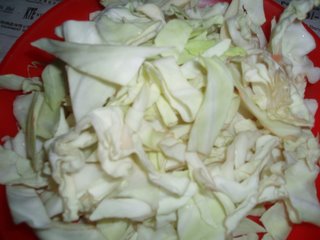
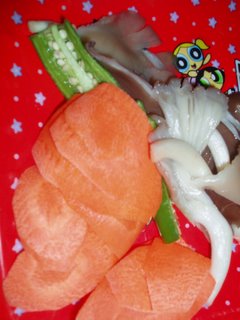
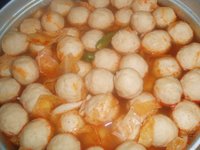 the result = mouth-watering tomyam ready to be eaten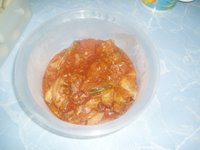
 no doubt these two dishes look gross (they are actually: i. sardines cooked with shallots & chillies and ii. fried sausages), but still; they managed to dissapear faster than the tomyam :D
 delicious moist cheese cake: supposed to be the dessert
 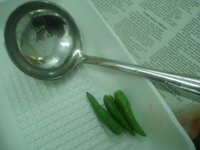 my masterpiece: of ladle and chillies, love the color contrast
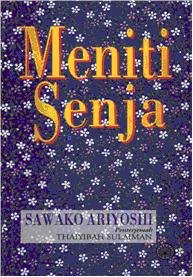
 Rasanya lirik lagu Ummi atau Mother nyanyian Sami Yusuf (Ya, lagi Sami Yusuf) paling sesuai menggambarkan perasaan saya: